Showing posts with label Local History. Show all posts

Tuesday, April 12, 2016

Mountain Monograms...U Ever Wonder Y?

Mountain Monograms!
Pleasant Grove's "G" with Mount Timpanogos looming above.

For as long as I can remember, the big white "G" on the mountainside east of my hometown of American Fork, Utah has been a part of the landscape of my life.  Every time my parents would take us on a drive we watched for the "G" that presided over the neighboring town of Pleasant Grove.  I always wondered what it meant.  What did that big "G" stand for?  One late summer night I looked out the window and was amazed and enchanted...the "G" was all aglow. That was when I learned that the "G" stood for Pleasant Grove High School and that it was all lit up for Homecoming.

The "G" from the hiking trail.

According to Wikipedia, in 1921, a group of seniors put a block letter "G" on an unnamed peak west of Mount Timpanogos.  The first time it was lit was in 1929.  There was once a Pleasant Grove holiday called "G Day" when the letter would be lighted and the townsfolk would celebrate.  The holiday was discontinued due to revelers causing damage to the football field.  Recently students raised $5,500 in a "Light the G" fundraiser to keep the icon lit on special occasions such as homecoming and graduation.

Why a G instead of a P?
It bothered me a lot back then, that Pleasant Grove used a G instead of a P.  It just didn't make sense to me.  I was doing some research online today and I think I may have come across the answer.  In the high school's early years, their mascot was known as the Pleasant Grove "Grover."  in 1959, the mascot was changed to the "Valkyrie" and eventually became the "Viking" which is the mascot today.


Distribution of Mountain Monograms Across the West
Notice the line of dots along the I-15 Corridor.

Mountain Monograms
The hillsides and mountainsides of Utah and other western states are adorned with big block letters...like the Block U of the University of Utah and the giant Y above Brigham Young University. Lately I have wondered why there are so many of them?  I wasn't even aware there was a term for such things...Mountain Monograms.  A definition from Wikipedia states "Hillside letters or mountain monograms are a form of geoglyph (more specifically hill figures) common in the American West. These are typically created and maintained by schools and towns.  Ranging in size from a few feet to hundreds of feet tall, they are an important part of western culture, symbols of school pride and community identity.  Water towers play a similar role in other parts of the country.  There is a popular myth that hillside letters were built so that early pilots could identify towns from the air in order to drop off "air mail."

The Big "C" in Berkley, California

Berkley's Big "C"...The First Mountain Monogram
According to online sources, the first three mountain monograms erected were due to class rivalries at universities.  The first letter was built in 1905 on Charter Hill overlooking the UC Berkley campus as a means of ending an unruly rivalry between the classes of 1907 and 1908.

The "Block U" of the University of Utah.
Size...a little over 100 ft. tall.

The "Block U."
A few weeks following the (1905) building of the Berkley "C,"  class rivalry between the sophomore and freshman classes of the University of Utah produced a hillside "U."
Students Repainting the "Block U."

The "Y" of Brigham Young University
The "Y" is 322 ft. in height and 120 feet wide.

"Y Mountain."
The following year, 1906,  Brigham Young University proposed the first 3-lettered hillside emblem, "BYU." After building the letter "Y", the school decided that it would be too much work to build the remaining letters.

Students apply hot lime...1908

Dr. Harvey Fletcher, the renowned scientist who graduated from BYU in 1907, wrote about the first Y Day in 1906, "The students stood in a zig zag line about 8 feet apart stretching from the bottom of the hill to the site of the Y.  The first man took the bag of lime, sand or rocks and carried it 8 feet and handed it to the next man.  The second carried it another 8 feet and handed it to the third man and thus the bag went up the hill, each man shuttling back and forth along his 8-foot portion of the trail."

This year Brigham Young University finally became the owner of Y Mountain.  Representative Jason Chaffetz sponsored a bill that was passed by Congress, allowing BYU to purchase the 80 acres surrounding the "Y."

Hillside Letters Across the West...
Even the fictional western town of Radiator Springs has a mountain monogram.

Closer View.

Hillside letters have been a part of my life for so long that I really didn't pay much attention to them any more...until recently.  Pulling out of the drive-thru of the Boulder City Mickey D's, I noticed this on a rocky mountainside:
Boulder City, Nevada.

It was like a bolt out of the blue...there had to be a story in these letters that seem to be everywhere! On my drive home I noticed letters on the hillsides of Parowan, Beaver, Fillmore, Nephi and Payson...and there are many more.  There are an estimated 72 hillside letters, messages and acronyms across the state of Utah...over 500 across the West and Canada.   For example, there are 81 in California, 45 in Nevada, 59 in Arizona and 34 in Idaho.  The densest concentrations are found along the Mormon Corridor in Utah, Idaho and the Los Angeles Basin.

Hole N' The Rock...tourist attraction near Moab.

On your next vintage vacation in the Old West, keep your eyes peeled for hillside letters.  They could be found in any little town with a big hill or mountain nearby.  I can't wait for my next car trip!


Thursday, January 7, 2016

When Dreams Are Drowned...Saint Thomas, Nevada!
Vintage Vacation...
Your trip into the past begins at Lake Mead National Recreation Area, Las Vegas, Nevada.
The turnoff is a dirt road just to the left after passing through the north entrance station.

St. Thomas, Nevada...
Thanksgiving Day 2015 George and I set out to discover St. Thomas for ourselves.

New Year's Day was the second time I had visited the ruins of old St. Thomas.  What remains of the town lies exposed on the dried up lake bed of Lake Mead.  The ongoing drought has left the town high and dry since about 2002...enough time for the NPS to construct a rude parking lot with a pit toilet and signage.  We knew almost nothing about the town on our first visit,Thanksgiving Day.  I took a lot of pictures, but they didn't have context.  Back at home I decided to research the history of the town.  I found a lot of old photos and a couple of maps with homes and buildings labeled.  George and I wanted to go back, so we invited my sister Patti and her husband Harold to come with us to Vegas for New Year's.  Harold has a bad heart, so Patti and I hiked the 2.5 mile trail, while George waited with Harold.  We were surprised to see so many families out...we had the place to ourselves in November.


A drowned house in Thistle.

I have always loved ghost towns and this one especially appealed to my imagination.  The reason? In April of 1983 there was a landslide in Spanish Fork Canyon about 50 miles south of here.  The slide dammed the Spanish Fork River and created a lake that drowned the small town of Thistle.  I was horrified at the thought of my high school art teacher, Evan Nelson, losing his home to the flood.  Years later, the rooftops of destroyed homes still float in marshes clogged with algae and the broken limbs of trees. I think this will make a good story for another time.

History of St. Thomas
The Construction of Boulder/Hoover Dam.

Thanks to good ol' Wikipedia and a blog called Ken's Photo Gallery  I was able to learn a lot about the history of St. Thomas. The town was founded by Mormon settlers in 1865, lead by Thomas Smith and at it's peak had a population of about 500.  Church records show that by the end of 1866, 45 families were living there growing cotton and other crops.  The town was near the confluence of the Muddy and Virgin rivers.  There was a reliable source of water, which is why the Anasazi and Basketmaker Culture had made their homes in the area for nearly 1000 years.  The Anasazi complex, now known as the Lost City was also flooded. In the 30's, archaeologists and the Civilian Conservation Corps rescued hundreds of artifacts that are now on display in the Lost City Museum in Overton.

Most of the Mormons left in February 1871 over a boundary dispute.  A land survey had shifted the state line of Nevada one degree longitude to the east, placing all the Mormon settlements in Nevada instead of Utah or Arizona. The state of Nevada then proceeded to collect back taxes for previous years payable only in gold.  The settlers chose to leave without paying.  Others moved in and claimed the abandoned properties.  A few Mormons returned in the 1880's.  


Vintage Post Card.

From Ken's Photo Gallery Blog: "The construction of Hoover Dam and the resulting rise in the waters of the Colorado River forced the abandonment of the town in 1938.  Before the water got there, most of the buildings were knocked down, dismantled or moved.  The orchards and many of the large shade trees were cut down so they wouldn't snag boats from the bottom of the lake.  Over the years the town has been under 50-70 feet of water.  Fast-forward 73 years to today, and a 9 [13]year drought has provided an opportunity to explore a ghost town.  Foundations, walls, and grated cisterns dot the site, along with numerous alkali-crusted trails branching in all directions.  The ruins of St. Thomas are protected by the National Park Service as a historic site.  The cemetery was relocated to Overton, Nevada where there is a St. Thomas interpretive center..." This is just a brief synopsis of the town's origins.  Visit Ken's Photo Gallery blog post for more information.

Map created by Ken for his blog.  
Patti and I used this map to locate the different buildings. 
I printed photos of the old buildings on the back of the map page.

Gentry Hotel Area...
The gracious Gentry Hotel.

Ruins of the Gentry Hotel


Ruins of the Gentry family home.
Located across the street from the hotel.

Harry Gentry General Merchandise.
Located just south of Gentry Hotel.

Salvaging at the post office.

Someone ordered a last day post office cover.
Mail was still being cancelled in roofless building.

St. Thomas School...

St. Thomas School before demolition.
The school was also used as a Mormon church and a town meeting hall.
The town had no police, jail, or town government.

Early 1930s School Children.
Note the rounded front steps.
"Recess was the highlight of the day.  We played all of those good games like OmpPomp Pullaway, Steal Sticks, Kick the Can, Run Sheep Run, marbles and baseball." --Euzell Prince Preston

St. Thomas School Bus.
"I remember when Marvae used to make taffy candy and bring it to school...soon as the bus stopped I ran to meet her. That candy was sure good." --Rachel Burgess Robbins.

George standing at the rounded front steps of the school.

Patti holds a photo of the school on the front steps.

Main Street...Highway 91.
The main street of St. Thomas was a continuous loop, not unlike a race track.
Not sure which part of the road this is.

Remains of Hannig Ice Cream Parlor

Ice Cream Parlor before front wall collapsed.
"The boys woke us...with their blasts of dynamite in the surrounding hills...There were parades, races...barrels of lemonade...And because July 4 was a special day, we were given a special treat...5 cents for an ice cream cone." --Inez Gibson Waymire

Lake Mead creeping up on this car.
The last resident, Hugh Lord left the town June 11, 1938.

Arrowhead Store.
St. Thomas became popular as a stopover on the Arrowhead Trail; the first automobile road from Los Angeles to Salt Lake City...later known as Highway 91.

Hand-drawn map available at the Lost City Museum in Overton.
The Lost City was an ancient Anasazi ruin also claimed by Lake Mead.

I am so glad we decided to go back to St. Thomas.  Knowing a little of the history made the town come alive for me and my sister.  George and I are constantly on the look-out for interesting places to visit in the Las Vegas area.  I am so glad I found the Ken's Photo Gallery Blog.  He has blogged about dozens of day trips he and his wife have taken since they retired to Henderson, Nevada.  When George retires, we will spend part of the winter in our Henderson place.  Until then, we will enjoy our long weekend visits...especially since our neighbors have stopped parking in our covered space...lol!

I hope you enjoyed this "Vintage Vacation."


Wednesday, July 16, 2014

Vintage Vacation...Come to Steel Days!


Steel Days!
"In the summertime when the weather is high
You can stretch right up and touch the sky
When the weather's fine
You got women, you got women on your mind
Have a drink, have a drive
Go out and see what you can find."
Mungo Jerry

In your youth was there a summer song...a special anthem that so typifies summer that all you have to do is hear the first line and you flash back to the sound of kids splashing in the neighborhood pool, the scent of coconut suntan lotion and the feel of hot concrete on your bare feet?   For me that song is "In the Summertime" by Mungo Jerry.  Just thinking of it...I saw myself at the pool in American Fork flirting with an older boy...and almost falling for his pickup line.  Not today, Romeo...I need to get home and get ready to go to the Steel Days carnival with my friends.


City of Fun Carnival...2010

Is there a small town in America that doesn't celebrate itself every summer with parades, rodeos and a carnival?  Usually the celebration focuses on an industry or crop or something historical.  Here in Utah County we have, for example, Strawberry Days, Lehi Round-Up, Onion Days, Pony Express Days, and the Ute Stampede.  Highland...where I live...has the Highland Fling.  Some of Highland's first residents were Scotts.  But in my heart I have always been an American Fork girl and our days are Steel Days!

Steel Days 2014 is going on now!

American Fork's celebration has evolved over the years.  In pioneer times it was Timber Day, an all-day picnic held in a grove of trees near town,  known as "The Timbers."  Eating and horseshoes competition, along with ball games and foot races were the main activities.  This tradition continued from 1865 until about 1904.

 Liberty Day...
Parade entry for Tennessee.

Liberty Day was a patriotic July celebration held either July 4 or July 24, which is Pioneer Day...or Days of '47... in Utah.  The dates alternated to please both the patriots and the pioneers.  This began in 1905. The biggest addition to the celebration was the grand parade.  Whether in horse-drawn wagons or decorated automobiles, parade participants moved very slowly over American Fork's gravel paved Main Street.  The parade of 1925 honored the various states of the Union.  A Goddess of Liberty was crowned to reign over the festivities.

Poultry Day
 
Poultry Day Parade...

Poultry Day began July 1927.  American Fork raised a lot of chickens in those days. The day began with a Sunrise Salute of cannon fire.  A free lunch of over 10,000 chicken sandwiches were passed out...our trademark product.  Pleasant Grove served strawberries and cream to their townspeople.  The first Poultry Day Queen was Miss Mary Pulley...one of American Fork's most beloved citizens. The last Poultry Day was July 1941; then Pearl Harbor was attacked.  There would be no more city celebrations until 1945.

Steel Days...at last!
A Nicely Dressed Family at Steel Days!

By 1945, the mayor of American Fork decided that Poultry Day no longer reflected the economy of our town.  World War II brought a lot of change to the area with the construction of the Columbia Steel mill...the largest employer in Utah Valley.  So Steel Days it would be!
  
I have many fond memories of Steel Days... but my very first memory is of leaving the carnival with my very own pretty balloon and watching it slip from my little four-year-old fingers.  I remember crying as I watched it fly away growing smaller and smaller until I could no longer see it.  That was the summer of 1959.  Would you like to take a Vintage Vacation trip back in time to Steel Days circa 1959?  Find a spot for your folding chair and wait for the parade to begin.

Note:  Photos are courtesy of Don Hansen from his grandfather Joe Hoglund.  These pictures are a mix from 1955, 1958 and 1959.

Steel Days Parade and Carnival 1959...

Blurry...but every parade has to start with the Color Guard
The background looks like a 50's classic car show.

American Fork High School Marching Band
I was in this band in 1971.

Miss American Fork
As a child my goal was to be Miss American Fork of 1973...just to ride on the float in a pretty dress and wave a princess wave.

Many floats were religious in theme.

Still 10 years from walking on the moon.

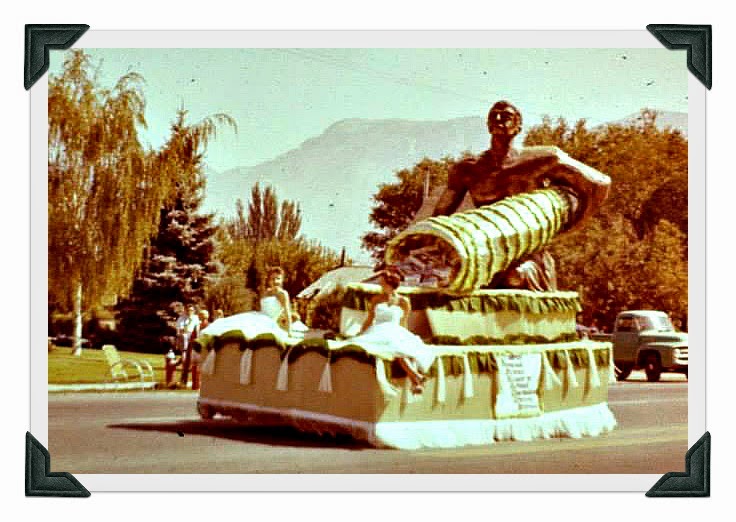
A Cornucopia of Blessings...or Prosperity I guess.

Devey's Float.
Devey's was an upscale shop owned by a distant relative.
My second choice float to ride on in a pretty dress.

Ship of Dreams.

The Cold War...or How I Stopped Worrying and Learned to Love the Bomb.
Just a couple of years before our air raid drills.

Carnival Time
LDS Wards had food stand fund-raisers.

The Giant Ferris Wheel!

Carousel!

Scary Clown Ride...yikes!

The Big Show!

The climax of Steel Days is the Big Show and Fireworks.  These days American Fork is able to attract major country and pop stars.  I don't know exactly when the Big Show started, but in 1962, my relative who owned Devey's...C. Richard Devey...was the Steel Days chairman.  The head of the entertainment committee approached him and asked if he could have $60 from the fund to hire a group of young kids from Ogden to perform for the evening.  The group was....

Osmonds in 1962...Andy Williams show.
...the Osmonds, with cute little Donny as well.  This was before their appearance on the Andy Williams Show in December.   I saw them perform at the Utah State Fair when I was in the fourth grade on a field trip.  They were singing barbershop music which I thought was pretty lame.  After all...who could compete with the Beatles?

One Last Parade Picture....

American Fork High School Marching Band 1971.
I am somewhere on the left in front of the drummers.
We played in every local parade all summer...it was a blast!

Happy Steel Days!
Note:  I found a lot of information about Steel Days in "American Fork City...The Growing Years" by Betty G. Spencer.